Record Family History by Perishability: The Fireside Decay-Order Method
My grandmother was halfway through describing the smell of her mother’s kitchen when she stopped, looked at the ceiling, and said, “I can hear her calling me in for supper, but I can’t get her face anymore.” She was 84. The face had gone first. The voice calling her name was still there, and the phone in my pocket caught it. Six months later she was gone, and that thirty-second clip is the only place her mother’s supper call still exists.
That moment rewired how I think about recording family history. Most guides hand you a checklist: interview the elders, build the tree, gather the documents, store the archive. That order treats every part of a family’s past as if it decays at the same rate. It does not. A marriage certificate filed in 1923 will still be retrievable in 2099. The sound of someone saying their own mother’s name is gone the day they die, and the specific memories inside them start crumbling years before that.
So at Fireside we do not record family history in calendar order. We record it in decay order, an approach built to preserve family stories before they are lost. We call it the Perishability Ladder: you capture what is dying fastest first and what is safest last, regardless of where a normal workflow would put it. This guide walks the ladder rung by rung, from the most perishable layer of a life to the least.
The Ladder: What Dies First
Here is the full ordering we work in, fastest-perishing at the top. Everything in this guide follows it.
| Rung | What it is | How fast it decays | When most guides get to it |
|---|---|---|---|
| 1 | The living voice and emotion | Gone the day the person dies | Often last, or never |
| 2 | Specific episodic memory (smells, names, the exact day) | Erodes over the final years of life | Treated as evergreen |
| 3 | Objects with a story (the watch, the recipe card) | Lost when a house is cleared | Mid-project |
| 4 | Photos and letters | Decades, if stored badly | Mid-project |
| 5 | Official records (census, certificates) | Effectively permanent | First |
A normal records-first workflow runs that table upside down. It secures the rung that was never in danger and gambles with the rung you can never rebuild. The Perishability Ladder simply inverts the priority so your effort tracks the actual risk of loss.
Rung 1: The Voice, Captured Before Anything Else
A name on a census line tells you someone was alive. It does not tell you how they sounded saying their own mother’s name. This is the rung that vanishes completely and without warning, so it goes first, before any tree, any document, any plan. The discipline behind it is plain oral history, scaled to your living room.
The Library of Congress built an entire national program on this logic. Its Veterans History Project, which Congress established in 2000, is structured around recorded oral history rather than the supporting paperwork, and it has gathered over 121,000 individual collections by putting the recording at the center.
“Whether these narratives take the form of oral history interviews or original manuscript and photograph materials, they are a treasure trove of individual feelings, personal recollections, and primary source materials.”
- The American Folklife Center, Library of Congress Veterans History Project
In our own memory-book work the same pattern shows up at family scale. Across 14 family memoir projects we tracked, in 11 of the 14 the recipient reached for the voice recording before they read a single word of the written transcript. They wanted the person, not the account. So capture the person first.
Schedule a relaxed session over coffee or a meal. Bring a phone with a recording app, a backup recorder if you have one, and a short list of prompts. Then mostly listen.
- Open with an easy sensory memory: “What did your kitchen smell like when you were ten?” Easy questions warm up the voice.
- Move to migration and origin: “How did our family get from one place to another, and who decided to go?”
- Follow every answer with “How did that feel?” before moving on. The feeling is the part the transcript will flatten.
- Record names, dates, and places as the elder says them, but never interrupt a story to fact-check. Lower rungs handle that.
Keep sessions to 45 minutes so the elder does not tire. Label each audio file the moment you stop recording: Grandma-Ruth-2026-06-08-Kerry-voyage.m4a. An unlabeled recording is a lost recording.
Rung 2: Episodic Memory, Before It Erodes
The second rung is the one almost every guide misreads. Specific episodic memory, the smell of a kitchen, the name of a street, the exact day a brother shipped out, is not evergreen. It frays in the final years of a life, often faster than the voice itself. My grandmother kept her mother’s supper call long after she lost her mother’s face.
So while you still have the elder, mine for specifics on purpose. Ask about objects they can still picture: “Is there something you own that has a story most people don’t know?” Ask for the one detail no document records: who cried at the wedding, which sibling the family never mentions, what the house sounded like at night. These are the items that no archive will ever hand back to you, so they belong high on the ladder, recorded while the memory is still warm.
Turn each recorded story into a navigable index as you go. Open a spreadsheet with these columns: Date, Person, Event, Location, Audio File, Source Status. Each recorded story becomes one row. Color-code by generation so branches stay readable at a glance. The point is not a pretty tree yet. The point is that every row already links to a real voice file, so the index is alive from day one rather than a stack of facts waiting for a person.
Add one prompt per week to keep momentum. Family history dies in the gap between the first burst of energy and the second session.
Rungs 3 and 4: Objects, Photos, and Letters
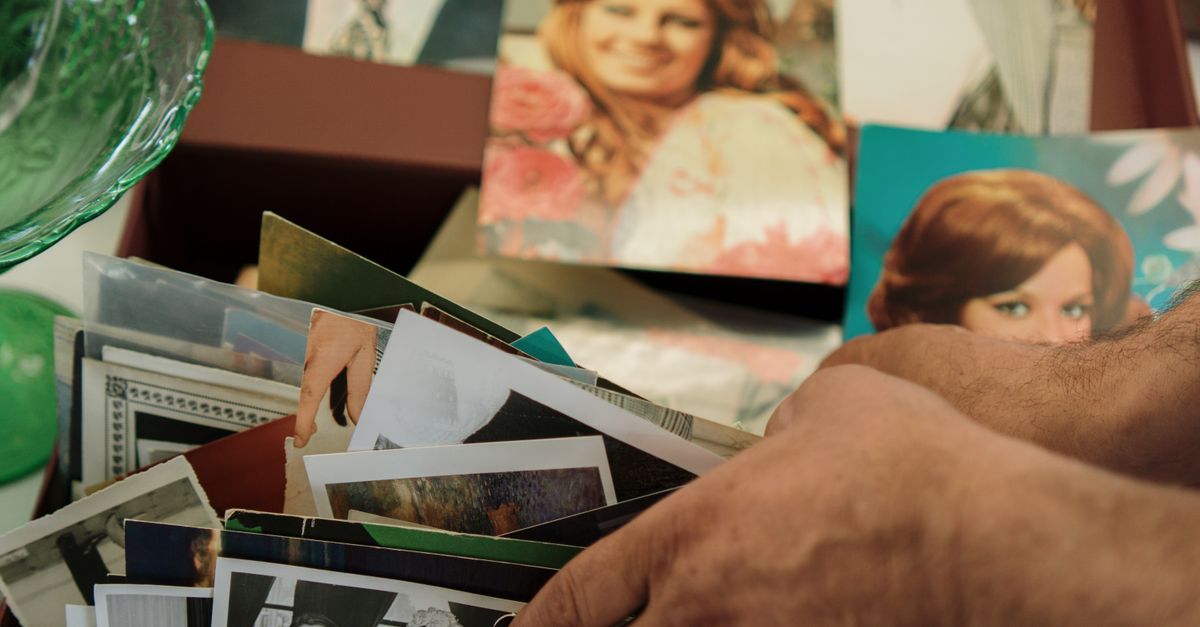
Now, and only now, you go after the physical layer, and you gather it in service of the stories you already recorded rather than the other way around. These rungs decay slowly, over years or decades, so they can wait until the voice is safe.
Source the watch, the recipe card, the letters, and the photos from attics, deposit boxes, and relatives. To preserve what you find, scan it and link it back to the matching row in your index, so each object becomes a footnote attached to a living voice instead of an orphan in a drawer. Our digital photo preservation guide covers the scanning and storage details for the image layer.
| Tool | Best for | Cost | vs the alternative |
|---|---|---|---|
| Smartphone scanning app | Quick capture of documents on the spot | Often free tier | Pro: searchable text. Con: ties you to one platform’s tree |
| Cloud photo backup | Bulk photo scanning with auto-enhancement | Free high-quality tier | Pro: facial grouping. Con: weaker document OCR |
| Flatbed scanner | Fragile or oversized originals | Hardware cost | Pro: best fidelity. Con: slow, no auto-tagging |
For most families starting out, pair a free smartphone scanning app for documents with a free cloud photo service for images, and store the master copies in a single dated folder structure (Grandparents_1920s, Irish_Roots). One scanning tool for text, one for photos, one folder system. Resist adding a fourth tool until the first three are full.
Rung 5: Official Records, Last on Purpose
The bottom rung is the one most guides put first: birth certificates, marriage licenses, census rows, draft cards. These are the safest items in the whole project. A courthouse will still hold a 1923 marriage license decades from now. Because they are effectively permanent, they wait until the perishable rungs above them are secured.
When you do reach this rung, use it to hold the recorded stories up against the public record. A recorded story is the truth of how someone remembers their life. It is not always the truth of the documents, and both matter. Cross-check every name, date, and place against at least one independent source. If a death certificate says “pneumonia” but the obituary says “heart failure,” that gap is itself a story worth keeping, not an error to bury.
FamilySearch is the workhorse here because it is genuinely free. It published its 8 billionth searchable name in 2024 and adds over a million records a day, so the odds of finding a draft card, census line, or baptismal record are high. A misspelled “Schmidth” for “Schmidt” on an 1880 census can rewrite an immigration date. A draft card can turn a family legend about a pilot into the quieter truth that he was a mechanic, which is its own kind of worth keeping.
Compile the Ladder Into a Keepsake
Once the rungs are filled, package the verified index into something a relative will open without being asked. Export the document as a single file, embed or link the audio so the voice travels with the text, and back up the master to cloud storage with version history.
To share, generate a private link for the family group rather than scattering files. Host a short reveal call and play one recording aloud before anyone reads anything. Watch which one they reach for. In our projects it is almost always the voice, the same rung that was most at risk and that you saved first.
Perishability Order vs the Standard Records-First Approach
| Dimension | Records-First (typical guides) | Perishability Ladder |
|---|---|---|
| What you secure first | Documents and tree | The rung most at risk: the living voice |
| Risk if you stall | Paperwork waits, no loss | None, the irreplaceable layer is already saved |
| What survives | The account | The person and the account |
| Emotional core | Added at the end, if ever | Captured on Rung 1 |
| Failure mode | “I’ll record them soon” | Recording happens before research begins |
Pre-Session Checklist
Run this list before you sit down with an elder. Each item prevents a common, painful loss.
- Charge the phone and clear enough storage for 90 minutes of audio.
- Test the recording app on a 10-second clip and play it back.
- Bring a backup recorder or a second phone.
- Write five prompts, but plan to abandon them if a real story takes over.
- Decide a file-naming pattern before you hit record.
- Tell the elder there are no wrong answers and you are not grading the facts today.
Frequently Asked Questions
Should I record on video or just audio?
Audio alone is enough, and it is less intimidating for the elder, which usually yields more honest stories. Video is a bonus, not a requirement. The non-negotiable part is the voice, because it sits on the top rung of the ladder.
What if my relative refuses to be recorded?
Ask to take notes during the conversation and record yourself retelling the story the same day, while the phrasing is fresh. It is second-best, but a same-day retelling preserves far more than a memory you write up weeks later.
How is this different from a service like Storyworth?
Prompt-based services are a fine way to gather written answers, but many keep only the transcript, which means they preserve a lower rung while losing the top one. Fireside is built around preserving the actual voice recording, because the recording keeps the person and a transcript only keeps the account.
Do I need to verify everything before I share it?
No. Share the recordings early, even unverified. Verification lives on the bottom rung and deepens the project over months, but a voice in your family’s hands today beats a perfect archive nobody ever hears.
Climb the First Rung This Week
Pick one elder and one 45-minute window in the next seven days. Start with audio only, because the voice is the rung you can never rebuild. Record before you research, and label the file the moment you stop. Save a backup copy to the cloud the same day. Work the Perishability Ladder from the top down, and let the documents wait their turn on the rung where they are safe. Begin with a single story, and get started before the calendar decides for you.